

Why should we not invest in equity? How I'd approach today's market.

Introduction
So yesterday I opened my LinkedIn and realized that I hadn’t posted for a while. I tried to come up with something but to no avail. Impulsively I asked my colleague to suggest a topic for a post and she said “Why should we not invest in equity?”. My first reaction was that I was being trolled. Because whenever we think of investment, we think of the equity markets. And when we think of savings we think of FDs and Post Office schemes. But then I looked at her again and she was serious. Then I thought, aren't both of these actually instruments of investment? So then why do we treat them so differently?
The answer lies in risk and returns:-
Equity Markets give us an unlimited upside potential and collects its dues with a very heavy risk. This is why we associate it with concepts like gambling, growth, return multiplier and get rich scheme/scam.
On the other hand there are FDs, Post office Schemes, G-sec Bonds among other debt instruments which we’ll refer to as debt markets. They provide a fixed upside potential limited to its coupon rate, if held to maturity, while providing safety in the form of low risk. This has associated it with concepts like savings, boring, slow, protection and planning.
Now neither is good or bad, better or worse. But yes, each has their merits and demerits that shine depending on the background and goals of the investor as well as the market conditions.
Let’s first look at market conditions since that is going to be the same for everyone right now.
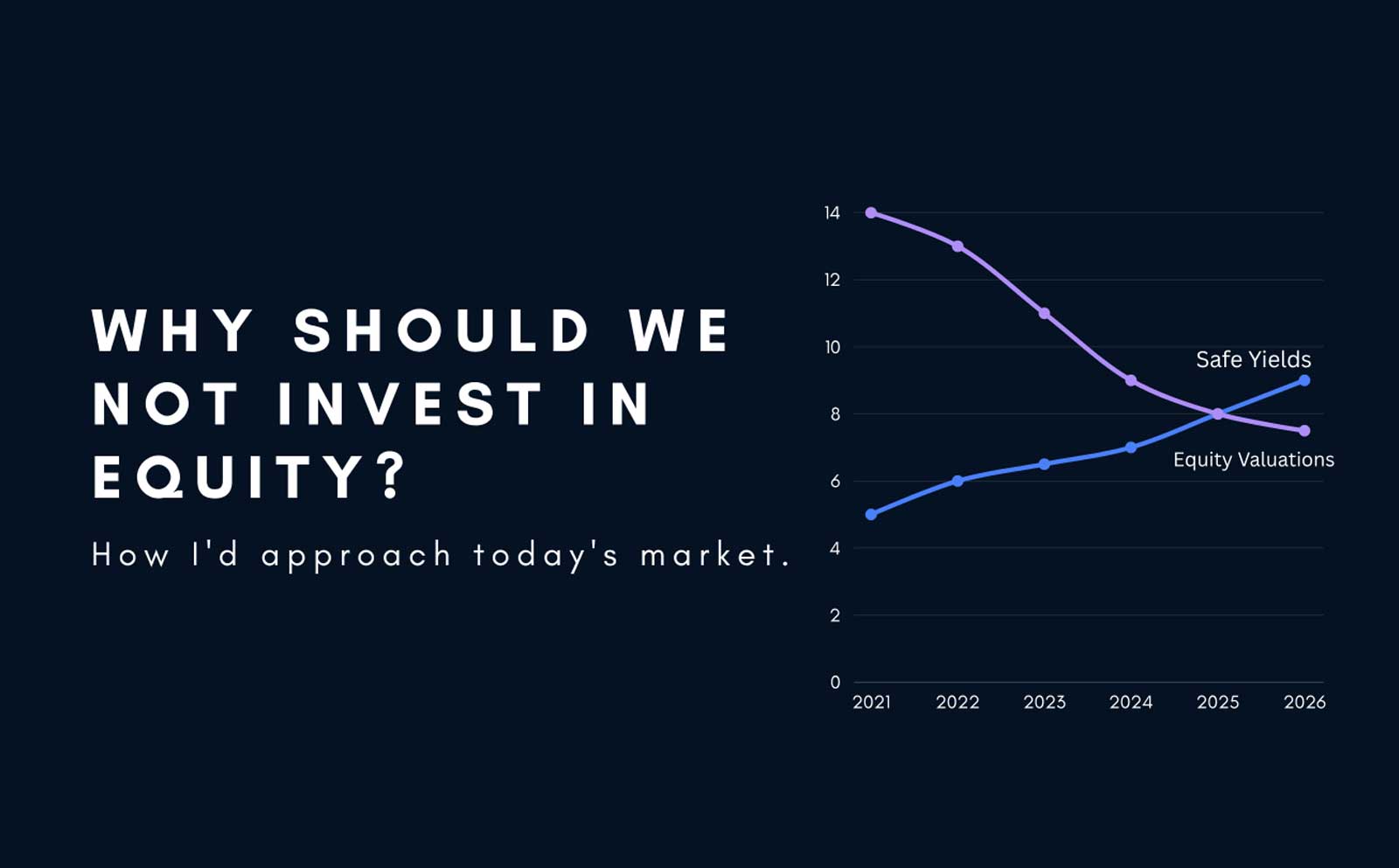
The current geopolitical scenario is filled with uncertainty. Conflicts and talks of war seem to be everywhere. The USD has long been the world's anchor currency, and with the Fed now raising rates again after three years, other central banks are following. This creates a scenario where debt deserves a bigger share.
Let's understand how:-
Understanding it Intuitively: Persistent inflation has pushed central banks to raise rates, so debt market rates have risen. At the same time, global uncertainty has weakened corporate outlooks, so equity markets are falling. So, higher safe yields mean equities now have to offer more return to justify their risk. Given the fact that debt markets are typically lower risk, they naturally deserve a bigger share right now.
Understanding it Mechanically: DCF is the most accepted way to value a company. It consists of Future Cash flows in the numerator which are discounted by the discount rate in the denominator. A component of the discount rate is the interest rates of the government bonds. So very simply if government interest rates go up so will the discount rate in the denominator which will bring the valuation of the company down given that the rest of the performance remains the same.
Now coming to the background and goals of the investor. This is much simpler. As understood from above equity markets are riskier with no assured returns but no limit on the returns either. While debt markets are safer with fixed returns.
Therefore if the investor’s future cash flows are non-existent or unreliable making their capital limited, then in that case debt markets are the better option. An example of this is someone who doesn’t have an active income or someone with a very volatile business.
On the other hand if the investor has regular and/or a stable income source, then equity markets can be a better option depending on the market conditions. An example of this is someone in the middle of their career with a regular job and/or a stable income source in the form a salary or regular rental income.
Strategy:
Now while the typical suggestion is to invest in debt markets over equity markets, it's important to understand that in a booming market, company valuations are sky high while in shaky markets like right now, valuations are often low giving investors a good buying price.
Given this, a good strategy can be to invest the majority in debt markets and use the coupon payments as something similar to an SWP to slowly buy into equity markets at low valuations. In this manner one can enjoy the high interest rates of debt markets while slowly buying the falling valuations of companies. Slowly is the key word here because one might be able to predict that valuations will fall but you can’t ever accurately predict the bottom of a falling market.
Takeaway:
This question, though seemingly absurd at first, got me thinking and acted as a reminder that there is no one strategy or investment that can be applied universally. Different instruments have different purposes and understanding when and why they shine is the key to building a successful portfolio with a smart and adaptive investment strategy.